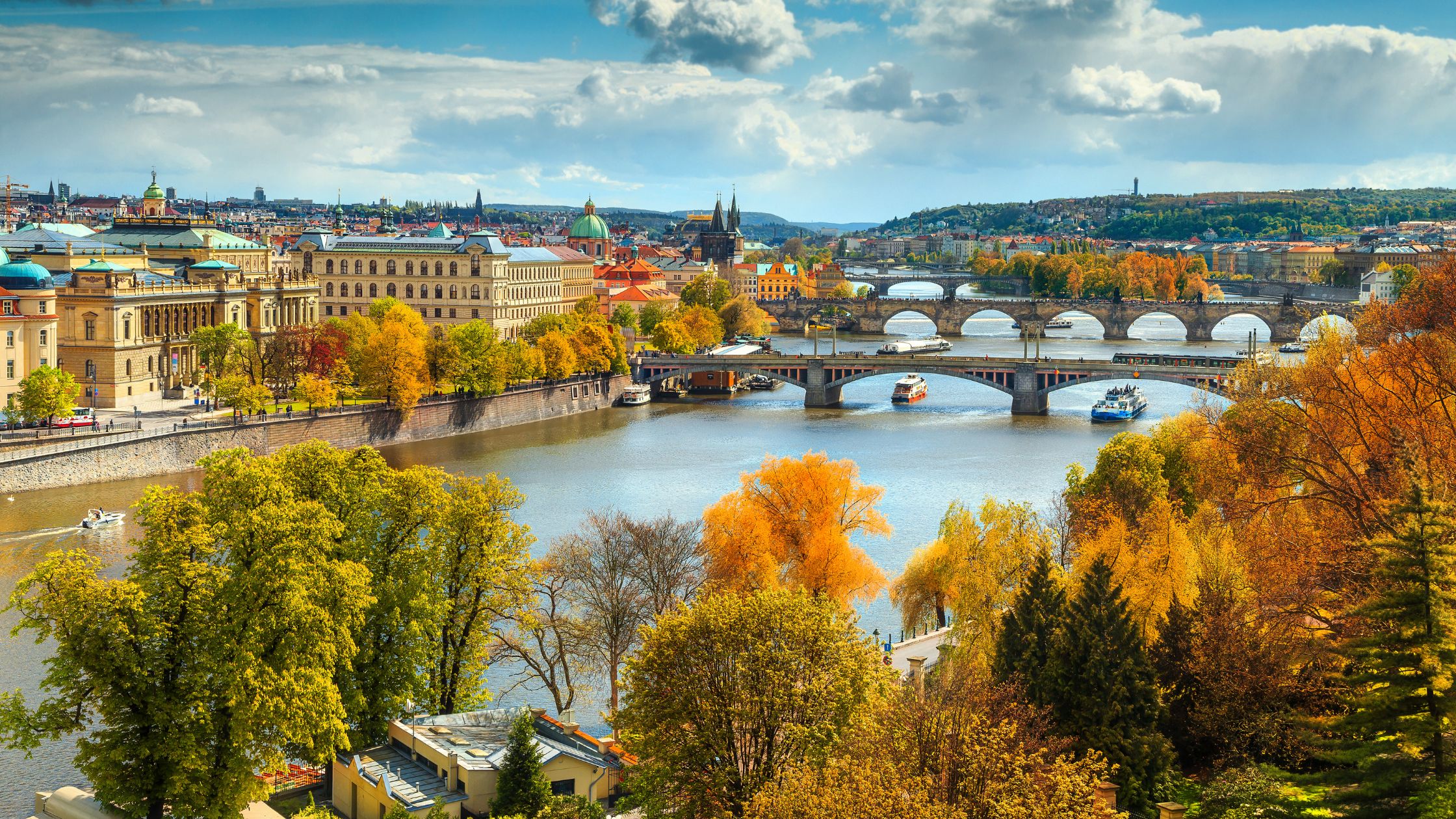

Czech Republic Unveiled: Where Crystal Lakes Mirror Castle Spires and Bohemian Dreams Come Alive
Imagine standing atop the Treetop Walkway at Lipno Lake, 40 meters above the Bohemian Forest canopy, where morning mist dissolves to reveal Austria’s Alps piercing the horizon while below, Czech Republic’s largest lake stretches like hammered silver across 48 square kilometers of possibility.
Now picture this same vantage point transformed—summer paddleboards dotting the surface like scattered flowers, autumn’s golden larches creating nature’s own stained glass, or winter’s frozen expanse becoming a playground for cross-country skiers tracing shoreline paths through snow-hushed forests.
There are plenty of things to do in the Czech Republic!
Czech Republic doesn’t merely offer attractions; it orchestrates experiences where medieval stones, crystalline waters, and cultural treasures converge into journeys that resonate long after your return.
From Prague Castle’s Gothic spires casting shadows across the Vltava to the underground boat rides through Punkevní Cave’s limestone cathedrals, from Mácha Lake’s sandy beaches echoing with children’s laughter to the wine-scented cycling paths of Moravian valleys, Czech Republic reveals itself as Europe’s most multifaceted jewel.
Whether you’re drawn to Karlovy Vary’s thermal colonnade during July’s film festival glamour, or prefer September’s grape harvest celebrations in Mikulov’s vineyard amphitheater, every season unveils different treasures.
Let’s navigate this remarkable tapestry together, revealing not just what to see, but how to weave these experiences into memories that capture Czech Republic’s soul through lakeshores, castle ramparts, and cobblestone squares.
Where Do Czech Lakes Create Their Most Magical Moments?
Lipno Lake: South Bohemia’s Aquatic Crown Jewel
Lipno Lake reigns as Czech Republic’s undisputed water playground, its construction in the 1950s flooding the upper Vltava valley to create what locals proudly call “the Czech Sea.” This isn’t hyperbole—the lake’s irregular shoreline creates countless coves and beaches, each offering different perspectives on South Bohemia’s forested majesty. Summer transforms Lipno into Central Europe’s lake district headquarters, where morning SUP sessions glide across mirror-still waters while afternoon winds provide perfect sailing conditions for the yacht club’s colorful fleet.
The lake’s crown jewel rises literally above the waterline—the Treetop Walkway (Stezka korunami stromů) spirals through ancient spruce canopy before culminating in a wooden tower where three countries converge in your viewpoint.
The surrounding infrastructure elevates Lipno beyond mere recreation: 48 kilometers of cycling paths circumnavigate the lake, connecting medieval monasteries, contemporary sculptures, and waterfront restaurants where pike-perch arrives with wild mushrooms foraged from surrounding forests.
Winter transforms Lipno into a different wonderland entirely. The Lipno Ski Resort’s family-friendly slopes cascade toward the frozen lake, while cross-country trails weave through silent forests. The Fox Park terrain park challenges snowboarders, yet the resort maintains an intimate, local character that larger Alpine destinations have lost. Evening finds families gathered in lakeside saunas, the contrast between steaming bodies and snow-covered lake creating that quintessentially Czech moment where pleasure derives from elemental contrasts.
Mácha Lake: Poetry and Beaches North of Prague
Mácha Lake serves as Prague’s beach escape just 65 kilometers north. The lake’s sandy shores, unusual for landlocked Czech Republic, create genuine seaside atmosphere complete with beach volleyball courts, windsurfing schools, and the essential summer soundtrack of children’s laughter mixing with ice cream vendors’ bells.
The twin towns of Doksy and Staré Splavy bookend the lake like guardians of different pleasures. Doksy offers the full resort experience—pedal boat rentals, waterfront restaurants, and evening promenades where Prague families stroll with three generations linked arm-in-arm. Staré Splavy maintains quieter charm, its pine-shaded shores perfect for contemplative swimming or sunset paddleboarding when the water transforms into liquid copper. The castle ruins of Bezděz loom above the northern shore, adding medieval romance to every photograph and providing hiking goals for those seeking elevation with their hydration.
Vranov Reservoir: Moravia’s Hidden Mediterranean
South Moravia’s Vranov Reservoir proves that Czech Republic’s best-kept aquatic secrets lie far from tourist thoroughfares. This serpentine body of water winds through the Podyjí National Park like a fjord transplanted to Central Europe, its steep forested banks plunging directly into waters that reach genuinely swimmable temperatures by June. The baroque Vranov nad Dyjí Castle perches impossibly above the reservoir’s narrowest point, its terraced gardens cascading toward the water in a display of 18th-century landscape ambition.
Summer weekends see Czech families claiming sandy coves accessible only by boat or forest trail, creating temporary communities where grills materialize from car trunks and children’s inflatable unicorns bob alongside fishing boats. The reservoir’s warmth—often reaching 24°C by August—makes it Czech Republic’s most Mediterranean experience, complete with waterside taverns serving Moravian wines that capture sunshine in liquid form. Through Lake.com, secure waterfront accommodations at Vranov Beach Resort, where morning swims begin directly from your terrace.
What Makes Prague’s Attractions Eternally Compelling?
Prague Castle Complex: Where Millennia Converge
Prague Castle doesn’t simply dominate the skyline—it defines Czech Republic’s entire historical narrative, its courtyards and chambers containing a thousand years of ambition, artistry, and architectural evolution. St. Vitus Cathedral rises from the complex’s heart like a Gothic prayer rendered in stone and stained glass, its windows by Alfons Mucha transforming sunlight into liquid color that pools on ancient floors. The castle experience transcends typical tourist circuits when you arrive at opening (9 AM in summer, 9:30 AM in winter), when morning light creates long shadows across empty courtyards and only pigeons witness your photographer’s joy.
The castle’s Golden Lane presents medieval life in miniature—tiny houses built into the fortification walls now housing exhibitions about their former inhabitants, including Franz Kafka’s sister Ottla. Yet the castle’s greatest gift might be its gardens, particularly the South Gardens cascading toward Lesser Town in a series of terraces where each level frames different city views. “Most visitors rush through the castle in two hours,” notes Marie Svobodová, a castle guide for two decades, “but spending four hours here, including coffee in the gardens, transforms it from checklist item to genuine experience.”
Charles Bridge and Old Town Square: The Eternal Stage
Charles Bridge performs different dramas throughout the day—contemplative at dawn when mist rises from the Vltava, chaotic at noon when tour groups create human traffic jams, magical at midnight when jazz musicians play for lovers rather than tips. The bridge’s 30 baroque statues create an open-air gallery where each saint tells stories through stone gestures, though most visitors miss the subtle detail that touching the bronze relief beneath the statue of St. John of Nepomuk brings good fortune and ensures your return to Prague.
Old Town Square operates as Prague’s beating heart, where the Astronomical Clock performs its hourly mechanical theater to assembled crowds who gasp despite knowing exactly what will happen. The square reveals different personalities with each season: summer transforms it into an outdoor restaurant, autumn brings farmers’ markets selling Moravian wines, winter’s Christmas market creates wooden village wonderland, while spring sees café tables multiplying like flowers. The Jewish Quarter (Josefov) lies minutes away, its synagogues and cemetery preserving Europe’s most intact Jewish heritage despite history’s repeated attempts at erasure.
Where Do Castles and Culture Define Czech Character?
Český Krumlov: The Storybook Made Real
Český Krumlov doesn’t merely preserve medieval architecture—it continues living within it, its UNESCO-protected old town wrapped in a perfect Vltava meander like a jewel in a river setting. The castle complex, Czech Republic’s second-largest after Prague, rises in a series of courtyards connected by covered bridges, culminating in a baroque theater where original 18th-century stage machinery still operates. Summer brings the International Music Festival (July-August), when renaissance courtyards become concert halls and baroque music floats across the river to listeners on opposite banks.
The town transforms after day-trippers depart. Evening light turns the castle tower rose-gold while restaurants along Latrán street spill onto cobblestones, creating an atmosphere more Italian than Bohemian. Morning delivers different magic—mist rising from the Vltava while you claim the castle gardens alone, or floating the river on traditional wooden rafts that provide perspectives impossible from land.
Karlštejn and Konopiště: Day-Trip Perfection
Karlštejn Castle rises from its limestone hill like something conjured from collective fairy-tale memory, its stepped silhouette visible from approaching trains adding anticipation to arrival. Built by Emperor Charles IV to house the Holy Roman Empire’s crown jewels, the castle’s Chapel of the Holy Cross contains 129 panel paintings and walls embedded with semi-precious stones creating medieval multimedia experience. The village below provides perfect post-castle wandering, its restaurants serving traditional svíčková (beef in cream sauce) best enjoyed with views back to illuminated ramparts.
Konopiště Castle reveals different character entirely—Archduke Franz Ferdinand’s personal obsession made manifest in 300,000 hunting trophies and an armory containing enough weapons to outfit a small army. The castle’s rose garden, planted according to Franz Ferdinand’s design, blooms spectacularly June through September, while the surrounding park’s lakes reflect both castle and clouds in compositions that explain why the Archduke chose this as his primary residence before his fateful trip to Sarajevo in 1914, the duke’s assassination being the very catalyst for World War I.
How Do Caves and Nature Parks Reveal Czech Republic’s Hidden Depths?
Moravian Karst: Underground Wonders
The Moravian Karst cave system near Brno creates subterranean theater where nature performs geological drama on a millennial scale. Punkevní Cave’s boat ride through limestone passages culminates in the Macocha Abyss, a collapsed cavern 138 meters deep where daylight penetrates creating natural cathedral lighting. The underground Punkva River maintains a constant 8°C, its waters so clear that depth becomes impossible to judge—what appears knee-deep might be several meters.
The surrounding landscape offers equally dramatic experiences above ground. The Macocha Gorge viewpoint platforms suspend visitors above the abyss, while hiking trails connect cave entrances through forests where every spring emerges from hidden underground streams. Reserve cave tours in advance, particularly for summer weekends when Czech families combine cave exploration with picnics in the surrounding forest.
Bohemian Switzerland: Sandstone Fantasies
Bohemian Switzerland National Park presents landscapes that seem imported from another planet—sandstone towers, natural arches, and narrow gorges where the Kamenice River has carved passages barely wide enough for boats. The Pravčická brána, Europe’s largest natural sandstone arch, spans 27 meters above forests that inspired romantic painters and continues attracting photographers seeking that perfect composition of stone, forest, and sky.
The Kamenice Gorge boat rides (operating May through October) provide different perspective entirely—silent electric boats navigate between vertical walls where ferns grow from impossible crevices and silence amplifies every water drop. Edmund Gorge and Wild Gorge offer different characters, the former more developed with boardwalks. Start from Hřensko, the park’s gateway village, where morning mist creates atmospheric conditions worthy of fantasy films.
Your Czech Adventure Awaits
Czech Republic rewards curiosity with experiences that transcend typical European itineraries. Gliding across Lipno Lake’s morning surface on a SUP board, exploring Punkevní Cave’s underground rivers, and watching sunset gild Prague Castle’s spires from Letná Park; each moment contributes to a journey uniquely yours.
The key lies in seasonal awareness and strategic geography. Combine Prague’s cultural treasures with Lipno Lake’s aquatic pleasures in summer, explore Moravian wine valleys during September’s harvest, or embrace December’s market magic before retreating to Karlovy Vary’s thermal embrace.
Czech Republic doesn’t demand choosing between nature and culture, activity and contemplation, tradition and innovation; it offers everything simultaneously, requiring only your presence to transform potential into memory.
Book your family vacation in the Czech Republic on Lake today to experience the country’s natural beauty and architectural splendor.