


Brown Bears, Volcanoes, and Alaska's Wild Peninsula Wilderness
Brown Bears, Volcanoes, and Alaska's Wild Peninsula Wilderness
Some national parks invite comparison. Lake Clark invites wonder. Set on the Alaska Peninsula about 100 miles southwest of Anchorage, this four-million-acre wilderness has no roads, no highway access, and fewer than 20,000 visitors in a typical year. It is, as more than one writer has described it, the essence of Alaska: three mountain ranges, two active volcanoes, glaciers, rainforest, tundra, wild rivers, and salmon-filled lakes, all compressed into a single park that most Americans have never heard of.
The park was designated in 1980 through the Alaska National Interest Lands Conservation Act and protects the headwaters of the Bristol Bay watershed, the largest sockeye salmon fishery in the world. The park’s namesake, Lake Clark, a 42-mile-long glacial lake of turquoise water in the Chigmit Mountains interior, is the heart of the park’s human settlement at Port Alsworth, where the Park Service maintains a visitor center and field headquarters. Private lodges are scattered around both the park interior and the Cook Inlet coastline, accessible only by floatplane.
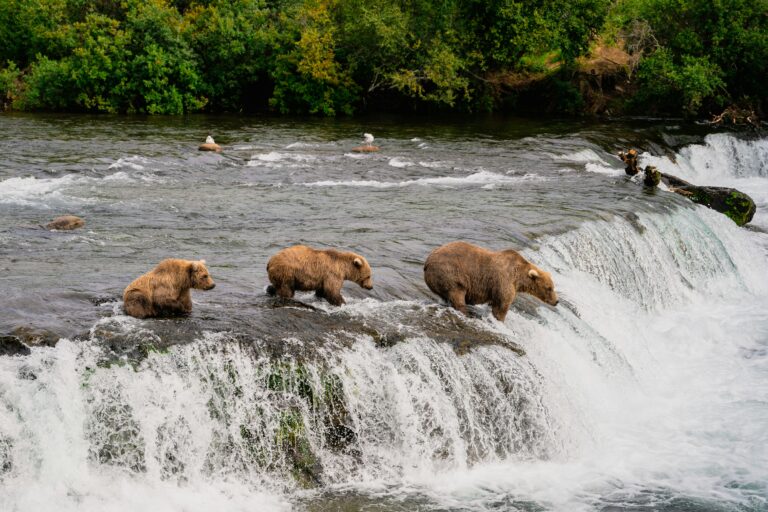
The coastal zone along Cook Inlet is where most visitor experiences center. Silver Salmon Creek and Chinitna Bay are world-class brown bear viewing destinations, where coastal bears graze salt marsh sedges in early summer and feed on salmon from July onward. Between June and early August, viewers may observe as many as 30 brown bears along the tidal marshes. Harbor seals pup in Tuxedni Bay in June. Beluga whales appear offshore. Puffins, cormorants, and kittiwakes nest on the rocky coastal cliffs. The combination of marine wildlife, large bears, and towering volcanic peaks visible across the water is simply without equivalent in the lower 48.
One of the most compelling specific destinations in the park is Twin Lakes, where the hand-built cabin of Richard Proenneke still stands on the shore of Upper Twin Lake. Proenneke lived in near-total solitude in this remote valley for more than 30 years, and his documentary films became the beloved 2003 PBS film Alone in the Wilderness. Free summer tours of the cabin are available through the park.
Access is entirely by air taxi from Anchorage, Homer, or Kenai, or by boat along the Cook Inlet coast when weather and tides permit. Anchorage and Homer are the natural staging communities, each offering vacation rentals, cozy lakeside homes, and comfortable lodges for nights before and after the expedition. Homer in particular provides a beautiful, relaxing coastal base with waterfront views, local seafood, and a thriving arts community.
Contact the park at 907-781-2218 or visit nps.gov/lacl for permit information, lodge operator lists, and bear safety guidance. Book your accommodations near Lake Clark National Park and Preserve.
Seasons
In spring, from April to May, temperatures range from 30°F to 50°F with unpredictable weather. Witness the awakening of wilderness as bears emerge and salmon start their run. While it’s less crowded, the harsh conditions make it challenging; ideal for hardened adventurers only.
Summer brings warm temperatures (60s-70s°F) and long days to this Alaskan wilderness. Witness the salmon run in July and August, and marvel at grizzly bears feasting on fish. Ideal for hiking, fishing, and bear viewing, with access via float planes and boats. Mild weather makes it a peak season for outdoor adventures.
Experience the allure of autumn from June to October, with warmer temperatures (40s-60s°F) and optimal bear viewing. Witness the annual salmon run, a spectacle that draws bears and adventurers alike. Crisp air and vibrant foliage make fall an ideal time to explore this pristine wilderness.
Winter, from November to April, brings temperatures as low as -40°F, heavy snowfall, and short daylight hours. Ideal for adventurous travelers seeking Northern Lights, snowshoeing, and cross-country skiing, but not for the faint of heart.
Top 3 Facts about Lake Clark National Park and Preserve
Lake Clark National Park and Preserve protects the headwaters of the Bristol Bay watershed, the largest sockeye salmon fishery in the world. The park’s four million acres are larger than the states of Rhode Island and Connecticut combined, yet the park has only about seven miles of maintained trails and no road access of any kind.
Mount Redoubt, at 10,197 feet, and Mount Iliamna, at 10,016 feet, are two active stratovolcanoes visible across Cook Inlet from the park’s coastal zone. Mount Redoubt erupted most recently in 2009, sending ash visible from 100 miles away. Both peaks are among the most prominent geographic features of the Aleutian volcanic arc.
Richard Proenneke’s hand-built cabin on Upper Twin Lake, where he lived in near-total wilderness solitude for more than 30 years starting in 1968, is now a National Historic Landmark within the park. His films of building the cabin and living off the land became the 2003 PBS documentary Alone in the Wilderness. Free guided cabin tours are offered during summer.
Travel Tips
Plan Ahead
There is no road access to Lake Clark National Park and Preserve. Plan all access by air taxi from Anchorage, Homer, or Kenai through licensed operators listed at nps.gov/lacl. Private lodge accommodations within the park must be booked well in advance, especially for bear viewing seasons in July and September. Obtain a free backcountry registration from the Port Alsworth Visitor Center before entering any wilderness area.
Pack Appropriately
Pack for highly variable Alaskan coastal conditions including waterproof layers, warm insulating mid-layers, and rain gear. Rubber boots are practical for coastal bear viewing areas with soft tundra and wet salt marsh. Bear spray is required for all backcountry travel. Bring a satellite communication device, as cell service does not exist in the park. All food must be stored in bear-resistant containers.
Respect Wildlife
Brown bears are present throughout the park and particularly concentrated along the Cook Inlet coastline during salmon season. Follow all bear viewing guidelines from the park service and licensed guides without exception. Maintain a minimum of 50 yards from all bears. Do not approach, feed, or position yourself between a bear and water or food sources. Harbor seals and beluga whales in coastal waters require quiet, undisturbed observation.
Stay Informed
Check nps.gov/lacl for current conditions, permit requirements, and licensed operator information before visiting. Monitor weather and volcanic activity forecasts for the Alaska Peninsula before any flight into the park, as weather changes rapidly and can delay air access for multiple days. Contact Port Alsworth Field Headquarters at 907-781-2218 for current park conditions and bear safety information.
- Area (mi²)
- 6297
- Annual visitors
- 18 278
- Established year
- 1980
Accessibility & permits
Emergency

Planning a trip?
Tell us about your upcoming trip and how we can help!
Frequently Asked Questions
Ready to dive into what Lake Clark National Park and Preserve has to offer? Let’s tackle some of the burning questions you might have as you plan your visit!
-
The closest city is Anchorage, which is about 100 miles northeast of the park. However, the only town within the park is Port Alsworth, located on Lake Clark. Anchorage is the major urban center nearest to the park.
-
The Tanalian Falls Trail is a good option for kids, as it is a moderate 4-mile round trip hike through a thick forest with glimpses of Lake Clark and a 30-foot waterfall at the end. The trail is relatively shorter and less strenuous compared to other trails in the area, making it more suitable for families and younger hikers.
-
You can bring your dog, but it must be on a leash. However, officials strongly advise against it due to the presence of bears, moose, wolves, and the risk of disease transmission. The park is also very remote and accessed by plane or boat.
-
Overnight RV parking is not allowed in the backcountry or wilderness areas. However, there are no specific campgrounds within the park that accommodate RVs, and the park’s camping is primarily primitive and geared towards backpacking and tent camping. RVs are not mentioned as an option for camping in the park.
-
The top attraction is bear viewing, which is one of the park’s most popular activities, allowing visitors to observe bears in their natural habitat. Another highly regarded attraction is the Twin Lakes, particularly Upper Twin Lake, where visitors can see the historic Proenneke Cabin and enjoy breathtaking views on a flightseeing tour. The Chilikadrotna River, known for excellent fishing, is also a favorite among visitors.