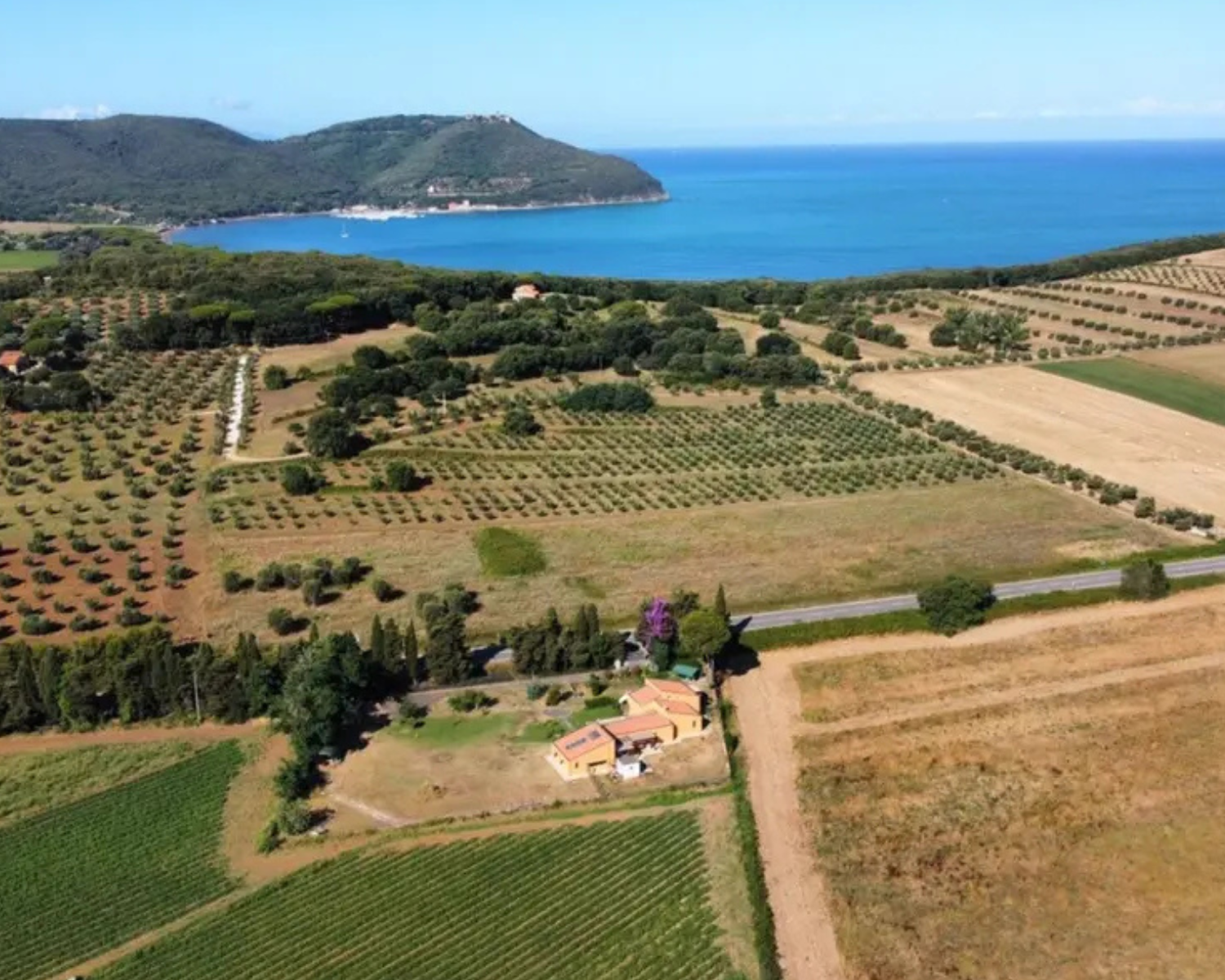
When Renata and her husband Pino first climbed the hillside above Baratti Bay, the building waiting for them didn’t look like the start of anything. The Tuscan coast retreat was half-swallowed by wild vegetation, its walls forgotten-looking, its future uncertain. There was no floor plan in hand, no business model, no clear idea of what it would become. There was only a feeling, sudden and specific, that something inside them had shifted.
They had been living in Milan at the time, worn down by grey light and traffic and a pace of life that left little room to breathe. Neither of them arrived at that hillside with the intention of opening a rental property. What they wanted was simpler and harder to name.
“We did not arrive in Baratti with a business plan. We arrived with a quiet desire to change direction.”
That desire became a years-long restoration, and eventually, a place called Le Caramelle di Baratti — a name that would go on to hold two studios, a garden, and a very particular philosophy about what it means to feel at ease in someone else’s house.
An Old Building, a New Direction
The renovation started as something private. Renata and Pino first imagined the building as a home for themselves, then as a gathering place for family, and only later as somewhere guests might stay. That order matters. It means the studios weren’t designed around what a listing photo needs to show. They were designed around what Renata had spent years learning about herself while traveling for work — namely, what she needed from a space in order to actually feel well in it.
She wanted room to spread out without feeling boxed in. She wanted a level of cleanliness bordering on ritual, the kind that quiets a busy mind rather than adding to its noise. And she wanted fewer objects competing for attention, because clutter, in her experience, doesn’t decorate a room so much as tax it.
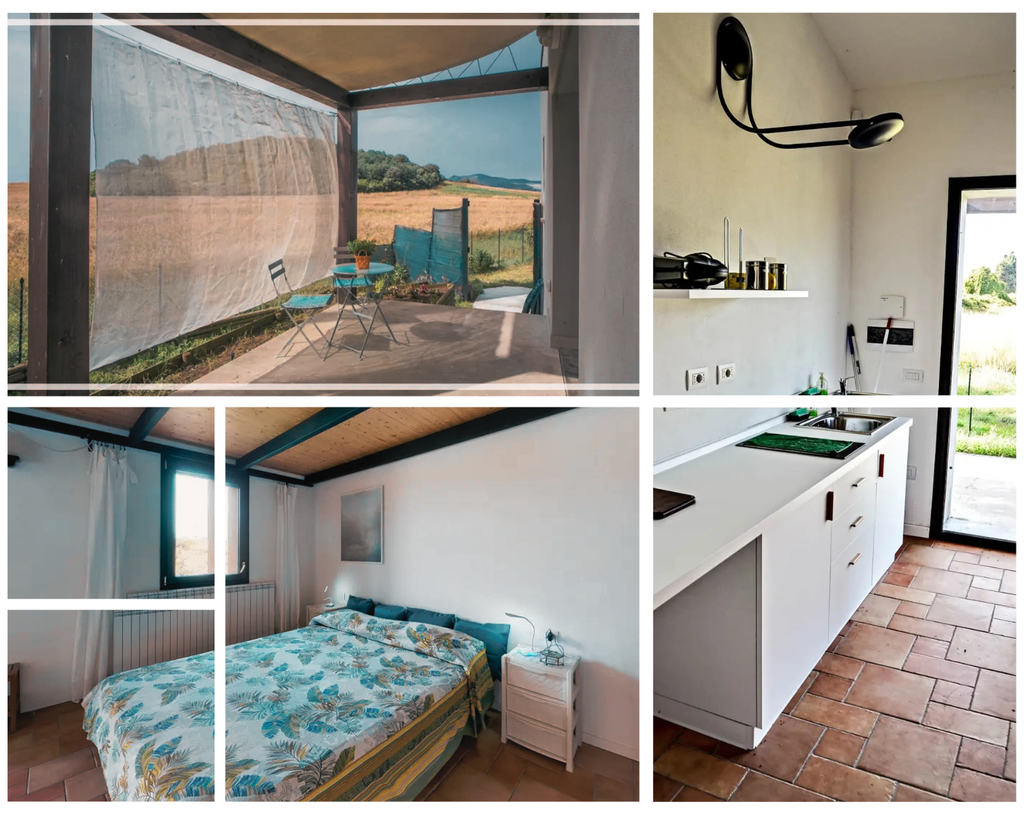
That philosophy shaped every choice in the restoration, down to the studios’ names. During construction, the two units became known simply as Orange and Green, a nod to an old Etruscan color scheme that Renata has come to think of differently. As two small spirits of the landscape itself, one holding the warmth of sunlit earth and evening light, the other carrying the shade and freshness of the hills behind the house.
The Property Itself
Walk into either studio and the first impression isn’t luxury. It’s relief. The layouts are simple and legible, the kitchens built for actual use rather than display, the air able to move through the space in a way that lets guests settle without effort. Renata has always trusted usefulness over decoration, and it shows in the restraint of the design.
Sustainability runs through the same decisions. From the earliest planning stages, she and Pino tried to build something that respected the rural coastline around it — attentive to energy use, careful about waste, shaped to belong to Baratti rather than announce itself over it. The house isn’t just built to host guests. It’s built to coexist with the land it sits on.
That coexistence extends to the small, practical touches guests don’t expect from a rental. The kitchens are stocked with more than the basics: cleaning essentials, laundry detergent, paper goods, and a bottle of Renata’s own extra virgin olive oil waiting on the counter. None of it is dramatic. All of it says the same thing — someone thought about what you’d actually need before you knew to ask.
Around the Tuscan Coast Area
Baratti Bay at Different Hours
Most visitors come expecting a beach and find something more atmospheric. The bay changes constantly through the day — the light, the wind, the whole feel of the place shift from morning to evening. Renata encourages guests to return to it more than once, precisely because it never looks the same way twice.
Populonia and Its Archaeological Park
A short distance from the house sits one of the region’s genuine landmarks: the Etruscan ruins of Populonia, set above sweeping views of the sea. It’s the kind of place that turns an afternoon walk into something closer to time travel.
A Local Winery
For guests who want to understand the area beyond its coastline, Renata points them toward a nearby winery, where the agricultural rhythm of this part of Tuscany becomes tangible rather than theoretical.
The Coastal Bike Route
A slow ride or scenic drive along the coast uncovers the corners a car or a beach towel would miss — the smaller inlets, the open views, the pace of a place that doesn’t need to be rushed.
A Day Trip Inland
Depending on the mood, Siena, Pisa, Bolgheri, or Livorno each offer a completely different Tuscany. Renata treats these as optional detours rather than obligations, something to reach for only if the day calls for it.
The Tuscan Coast Retreat Guest Experience
Ask Renata what she looks forward to most, and she doesn’t describe a single dramatic event. She describes something quieter and more reliable: a transformation that tends to happen around the second day.
Guests usually arrive a little tired, still moving at the pace of wherever they came from. Then, gradually, something loosens. Their faces soften. They start moving like people who belong somewhere, cycling to the shop, walking back from the beach with color in their skin and a different rhythm in their step.
“I love seeing that quiet happiness in motion — people enjoying themselves, moving freely, smiling without effort.”
It’s not the kind of story that makes a highlight reel. It’s better described as evidence — proof, repeated stay after stay, that the calm Renata built into the house does what she hoped it would.
That instinct toward care extends to how she handles the harder moments too. Nine years ago, early in her hosting life, a guest had to leave partway through a non-refundable stay. Renata wasn’t obligated to return anything. She wanted to anyway, but she was new enough to worry about getting the paperwork wrong. A property management system she’d already invested in gave her the tools to issue the refund properly, without creating a mess on the back end.
“It taught me that hospitality should be human, but it also needs structure.”
It’s a small story, but it explains something larger about how she runs the place — instinct first, systems close behind to make sure the instinct holds.
Planning Your Stay to a Tuscan Coast Retreat
For a guest with only a weekend, Renata’s sequence rarely changes. Start slow at Baratti Bay, letting the morning light do its work. Then head to Buca delle Fate, a beach with a wildness and drama that borders on mythic. For dinner, she sends people to La Taverna dei Buoncompagni or Garibaldi Innamorato, both of which tell the region’s story through food rather than description. As the sun drops, an aperitivo at Canessa or La Baracchina slows the whole bay down with it. For anyone with energy left, the night ends with music by the sea at Bagno Baratti.
Longer stays open the door to Florence, San Gimignano, and further stretches of the Tuscan coast, but Renata is careful not to oversell the itinerary. Guests booking further in advance, particularly those traveling long distances, can also opt into an insured, reimbursable BeSafe rate — a way of keeping the excitement of planning a trip from Tuscany without the anxiety of committing to it too early.
Renata doesn’t try to sell Baratti on arrival, and she doesn’t expect her guests to fall for it immediately either.
“This is not a destination that needs to shout. Baratti reveals itself slowly.”
Give it a few days, and it tends to stay with you long after you’ve packed the car and driven back toward whatever grey city you came from.