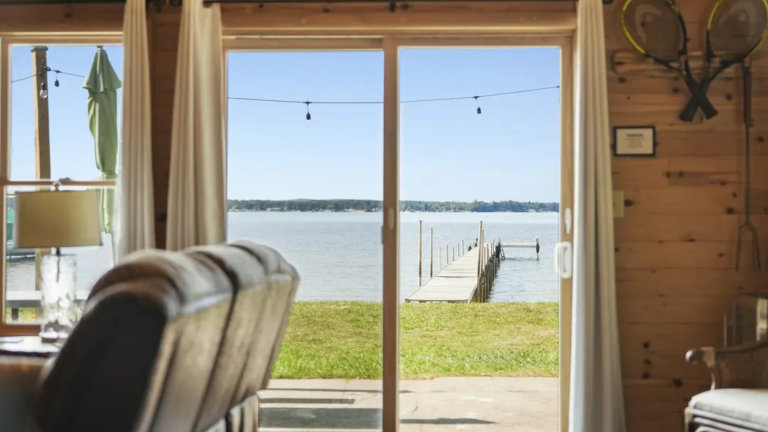

The lake trip idea gets floated, the group says yes, and then somebody has to send a number. That’s when it gets complicated. So let’s talk about how to split the cost of a lake house rental fairly — by household, bedroom, person, or means — plus the fee trap to check before anyone pays.
Not because people are unreasonable. Not because anyone is trying to take advantage of anyone else. But because a multi-family lake house rental involves more variables than a simple split can absorb — different family sizes, different incomes, different travel distances, different bedrooms occupied, and at least one family who mentioned early that they’re watching their budget this year. The math is straightforward. The conversation around it almost never is.
Our pillar guide to the best lakes for family vacations named cost-splitting as the fourth and hardest question in the “how to actually choose” framework — specifically because it’s the one most likely to derail a trip that everyone nominally agreed to. The guide to waterfront vs. lake-view rentals flagged it as a consequence of property type: a waterfront house that’s right for the group might require a number that not everyone can comfortably say yes to. This piece is the full treatment of both. Not just the math, but the approach that makes the math land without creating a problem alongside it.
The Fee Problem Nobody Sees Coming
Before any splitting method can work, the number being split has to be the real number. This is where most group trips run into trouble before a single conversation about fairness has even started.
A rental listing with a headline price of $4,200 for the week can arrive at checkout looking considerably different. Cleaning fees, service fees, platform fees, and in some cases pet fees — each disclosed at a different stage of the booking process, or not disclosed until the final confirmation screen — can add meaningfully to the number the group originally agreed to split. The family member who forwarded the listing with the $4,200 headline is now explaining why the actual charge is $5,100, and that explanation happens after everyone has already committed.
Fee transparency isn’t a platform feature — it’s a group dynamics problem in disguise.
A rental booked through a platform with 0% guest fees means the number in the listing is the number that appears at checkout, which means the number the group agreed to split is the number that actually gets split. No explanation required. No retroactive renegotiation. One less conversation that shouldn’t have to happen.
It’s worth verifying this upfront regardless of which platform the group is using: before sharing a listing with the group, confirm what the total checkout cost actually is, including every fee, and make that the number that goes into the chat. The headline price is not the number to split.
Four Ways How to Split the Cost of a Lake House Rental
There is no universally fair method. There is only the method that matches the specific shape of the group in front of you. Here are the four most common frameworks, when each one works, and when it doesn’t.
By Household
The simplest split: total cost divided by the number of families in the group, regardless of how many people each family brought. A couple and a family of five each pay the same share. When it works: groups where family units are roughly similar in size, income levels are comparable, and the social dynamic strongly favors simplicity over precision. When it doesn’t? When one household is a retired couple and another is a family of six, or when travel distances are visibly unequal. Equal household splits feel fair in the abstract and may generate resentment in practice when the underlying circumstances are not.
By Bedroom
Each family pays for the bedrooms it occupies, with the total rental cost allocated proportionally by bedroom count. When it works: groups where families occupy distinctly different configurations — a primary suite versus standard rooms — and where a per-bedroom allocation feels intuitively connected to what each family is actually getting. This method also fits naturally with the multi-generational guide’s recommendation of one bedroom per family unit: the cost follows the space. When it doesn’t: when room sizes are similar enough that allocating by bedroom feels like false precision, or when a family is occupying a larger room for practical reasons — a grandparent who needs the ground floor — and shouldn’t absorb a larger share because of it.
By Person
Total cost divided by the number of people in the house, with children sometimes counted at a half-share depending on the group’s preference. When it works: groups with significant variation in household size, where a per-household split would create obvious inequity. Per-person is the method that most closely approximates what each person is actually consuming. When it doesn’t: when income variation in the group is significant enough that a pure headcount split puts one family in a genuinely uncomfortable position. It’s the most arithmetically fair method and the one most likely to create a quiet problem for the family who said yes before doing the math.
By Means
A contribution model where each family pays a share calibrated to what they can reasonably afford, with higher-income households absorbing more than a straight equal split would assign. When it works: close families with long histories of honest financial communication, where everyone already knows roughly what everyone else earns and the group has decided that the trip matters more than equal arithmetic. When it doesn’t: when the income differential isn’t actually known — or assumed incorrectly — or when one family feels the weight of being the subsidizer in a way that quietly changes the trip dynamic. This method requires the most trust and the most explicit conversation, and it should only be used by groups that genuinely have both.
The Conversation to Have Before Anyone Opens a Listing
The splitting method is the second conversation. The first one — and the one most groups skip — is the number.
Before any specific rental is on the table, before anyone has fallen in love with a view or a dock or a particular week, the group needs to agree on what each family can spend. Not a range. A number.
The number that, if the rental comes in under it, everyone feels good, and if it comes in over it, one family has to quietly absorb a share they can’t really afford rather than say so in front of the group. This conversation is uncomfortable for about four minutes and saves several uncomfortable conversations later.
It also determines the property type. Whether the group can afford waterfront, or whether a well-chosen lake-view rental is the version that keeps the trip financially comfortable for everyone. As the waterfront vs. lake-view guide covers, the price difference between those categories can be substantial and September, when rental rates ease alongside search demand, is often the window where a group that originally thought waterfront was out of reach finds that the math has shifted in their favor.
Set the budget per family before the search starts. Agree on the splitting method before a specific house generates opinions. Let the search happen inside the constraint rather than trying to retrofit the constraint onto a house someone already wants.
The trip everyone says yes to is the one where the yes was fully informed — including the part about what it costs.